Boda Boda: What It Means and How It Works in Kenya
If you've ever stood at a Nairobi junction and heard someone shout "boda boda!" while waving you toward a motorcycle, you've already met Kenya's most practical form of transport. A boda boda is a motorcycle taxi, though the term also covers the bicycle taxis that came before it, and it now moves millions of people through towns and villages across East Africa every single day.
The name itself has a story. Boda boda meaning traces back to the border towns of Busia and Malaba, where cyclists once shouted "border, border" to ferry travelers across the gap between Kenya and Uganda when vehicles couldn't cross. That border call stuck, and the boda boda motorcycle became the go-to answer for short trips, tight budgets, and roads too narrow or too jammed for cars.
This article breaks down what boda boda in Kenya actually means today, from its origin story to how riders operate, what makes it different from a regular taxi, and why it remains the fastest way to beat Nairobi traffic. If you're new to the term or just want the full picture before your next ride, you're in the right place.
Why boda bodas matter to Kenya's transport system
Nairobi's traffic jams are legendary, and that's exactly why the boda boda industry has grown into one of the country's biggest employers. Estimates from the World Bank put the number of motorcycle taxi riders across Kenya at well over a million, most of them young men who couldn't find formal jobs but could afford a motorbike on a loan. Every ride you take puts money directly into a rider's pocket, and that money often supports an entire household. A boda boda motorcycle parked outside a shopping center isn't just a taxi, it's someone's livelihood.
A boda boda doesn't just move you across town, it moves an entire family's income.
Reaching where cars can't
Matatus and taxis stick to tarmac, but boda boda in Kenya goes where the road stops being a road. Riders navigate flooded estates during the rainy season, cut through footpaths in informal settlements, and reach farms down dirt tracks that a saloon car would never survive. This access matters far beyond convenience:
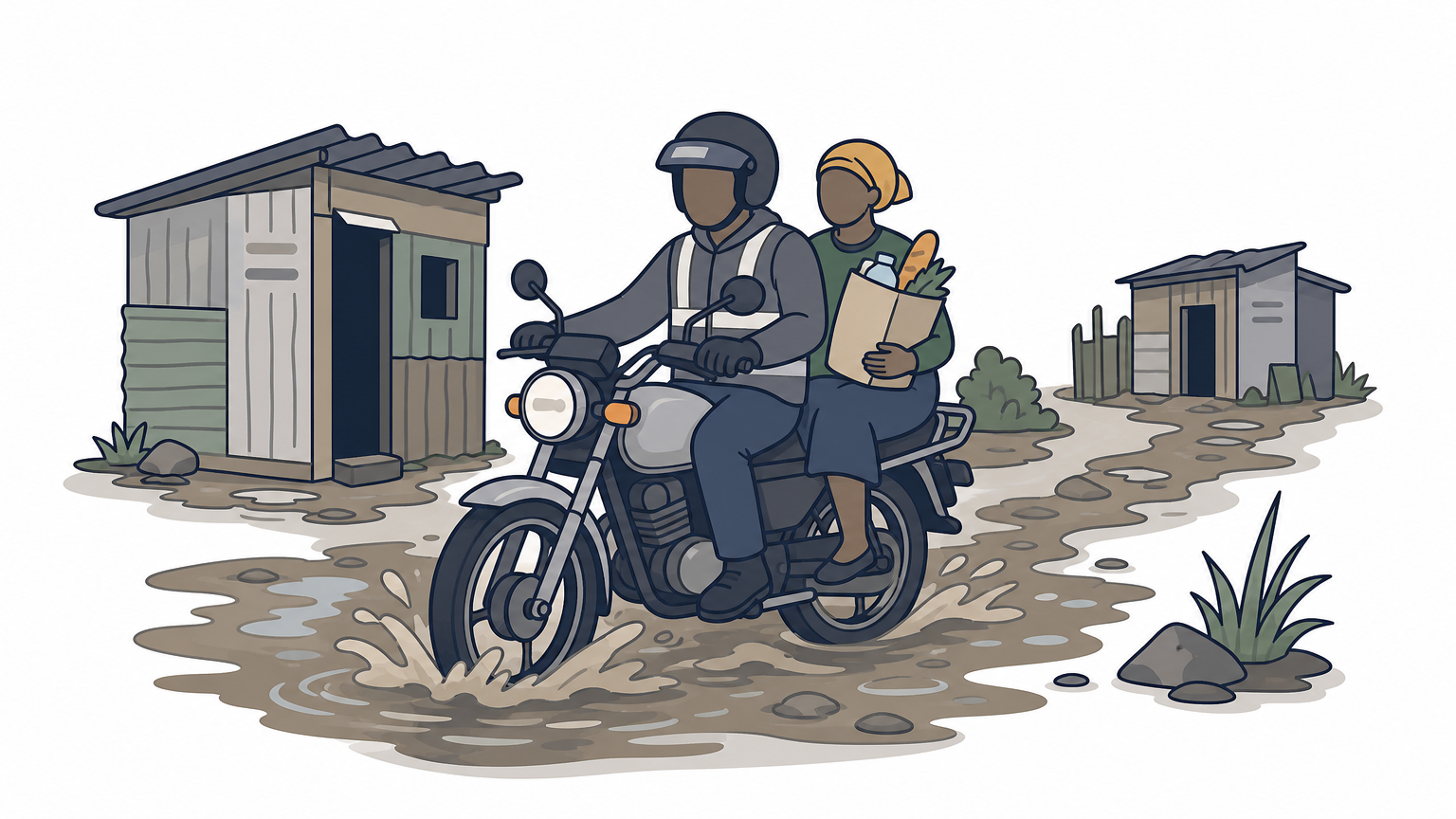
- Rural connectivity: villages with no matatu route depend entirely on bodas to reach clinics, markets, and schools.
- First and last mile: commuters ride a boda from home to the nearest matatu stage, then again from the stage to the office.
- Emergency transport: in areas without ambulance coverage, a boda is often the fastest way to reach a hospital.
- Flood and construction detours: when roads become impassable for cars, motorcycles keep moving.
Factor in how many small businesses rely on bodas for quick deliveries, from grocery runs to parcel drop-offs, and you start to see why the sector doesn't just support transport. It supports commerce, healthcare access, and daily survival for millions of Kenyans who'd otherwise be stranded.
How boda boda rides work in practice
Finding a boda boda used to mean flagging one down at a stage, haggling over price, and hoping the rider knew the route. That system still exists in most towns, but booking a boda boda in Nairobi has moved a lot of this online. Ordering a boda boda through an app like eTaxi's boda service means you skip the negotiation entirely: you open the app, drop a pin, and see an upfront fare before you commit to the ride.
The best boda boda ride is the one where you never have to argue about the price.
From pickup to drop-off
Getting matched with a rider follows a predictable sequence, whether you're hailing on the street or booking through an app:
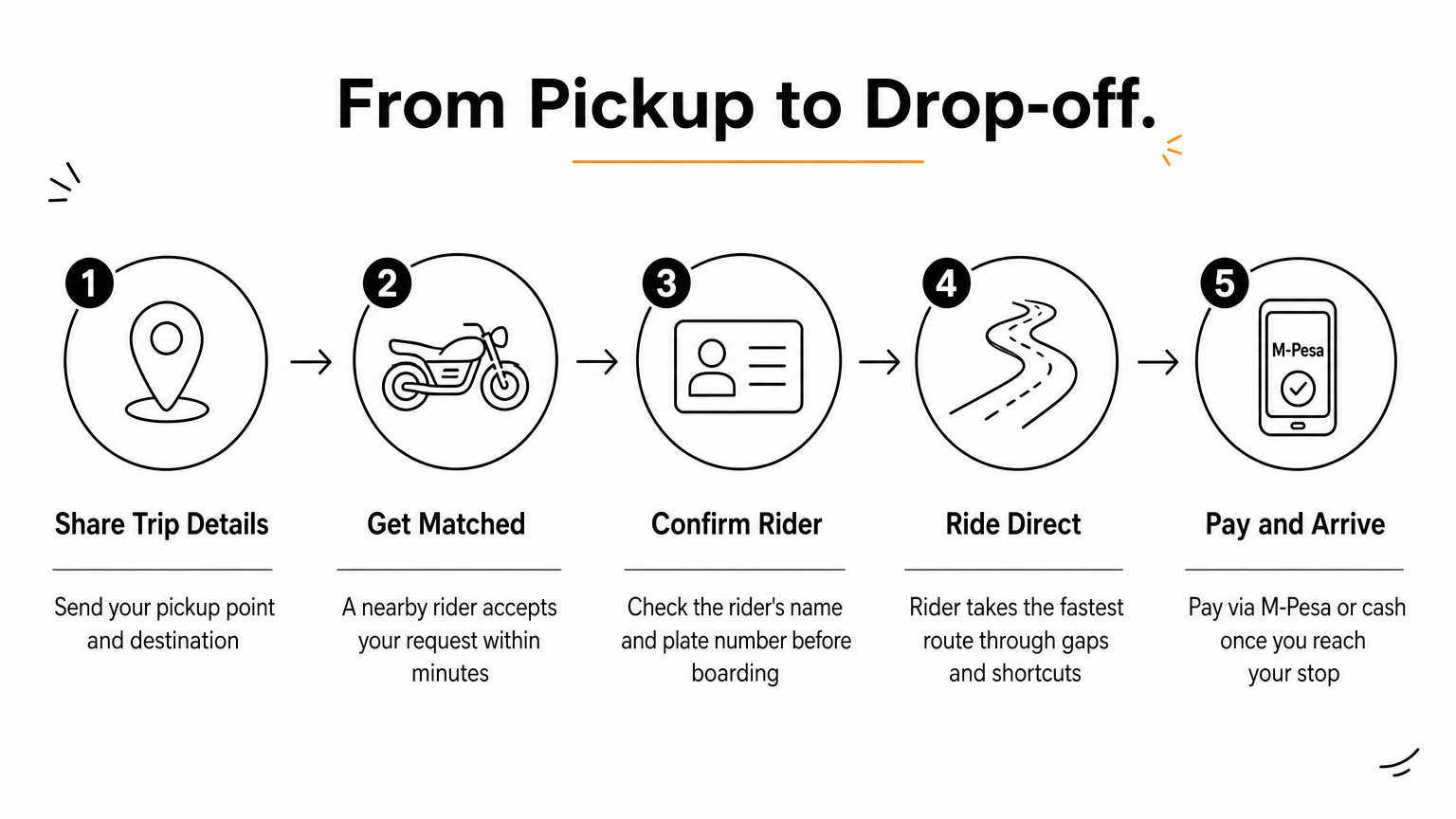
- You share your pickup point and destination.
- A nearby rider gets matched to your request, usually within minutes.
- You confirm the rider's name and plate number before boarding.
- The rider takes the most direct route, often weaving through gaps cars can't use.
- You pay via M-Pesa or cash once you arrive.
Why app-based bookings changed the game
Street-hailed rides still dominate in smaller towns, but app bookings solve two problems: fare transparency and trip tracking. You know the cost before you climb on, and a trusted contact can follow your route in real time. That shift matters most for women riding alone at night or anyone unfamiliar with a neighborhood's usual boda rates.
Tips for riding a boda boda safely
Staying safe on a boda boda comes down to habits you control, not luck. Kenyan roads mix matatus, trucks, and pedestrians in tight spaces, so a rider's skill only gets you halfway there. The rest depends on what you do before and during the trip.
A helmet costs you nothing until the one day it saves your life.
Before you climb on
Getting these basics right takes seconds but cuts your risk dramatically:
- Check for a helmet: refuse the ride if the rider can't offer you one, no exceptions.
- Confirm the plate number: match it against what the app shows, or note it down if you flagged the rider on the street.
- Share your trip: send your live location to someone you trust, especially at night.
- Agree on the fare upfront: this avoids arguments at the destination and is one reason app bookings beat street hailing.
During the ride
Hold onto the grab rail or the rider's waist, not their shoulders, and keep both feet on the pegs. Speak up if the rider is speeding or weaving recklessly. Most riders depend on repeat customers, so a firm reminder to slow down usually works.
After dark
Nighttime rides call for extra caution. Stick to routes you know, avoid deserted shortcuts, and prefer riders with visible reflective gear or a lit number plate. Booking through an app rather than hailing on a dark street also gives you a verified rider record, which matters if anything goes wrong.
Boda boda compared with other transport options
Every Nairobi commuter eventually asks the same question: boda, matatu, or car? Each option trades off speed, cost, and comfort differently, and knowing which one fits your trip saves you both time and money. A boda boda wins on speed through traffic but loses on comfort during rain or long distances. A car ride booked through eTaxi gives you shelter and space but costs more and moves slower in a jam. Matatus stay the cheapest option but run fixed routes and fixed schedules, so they rarely match your exact pickup point.
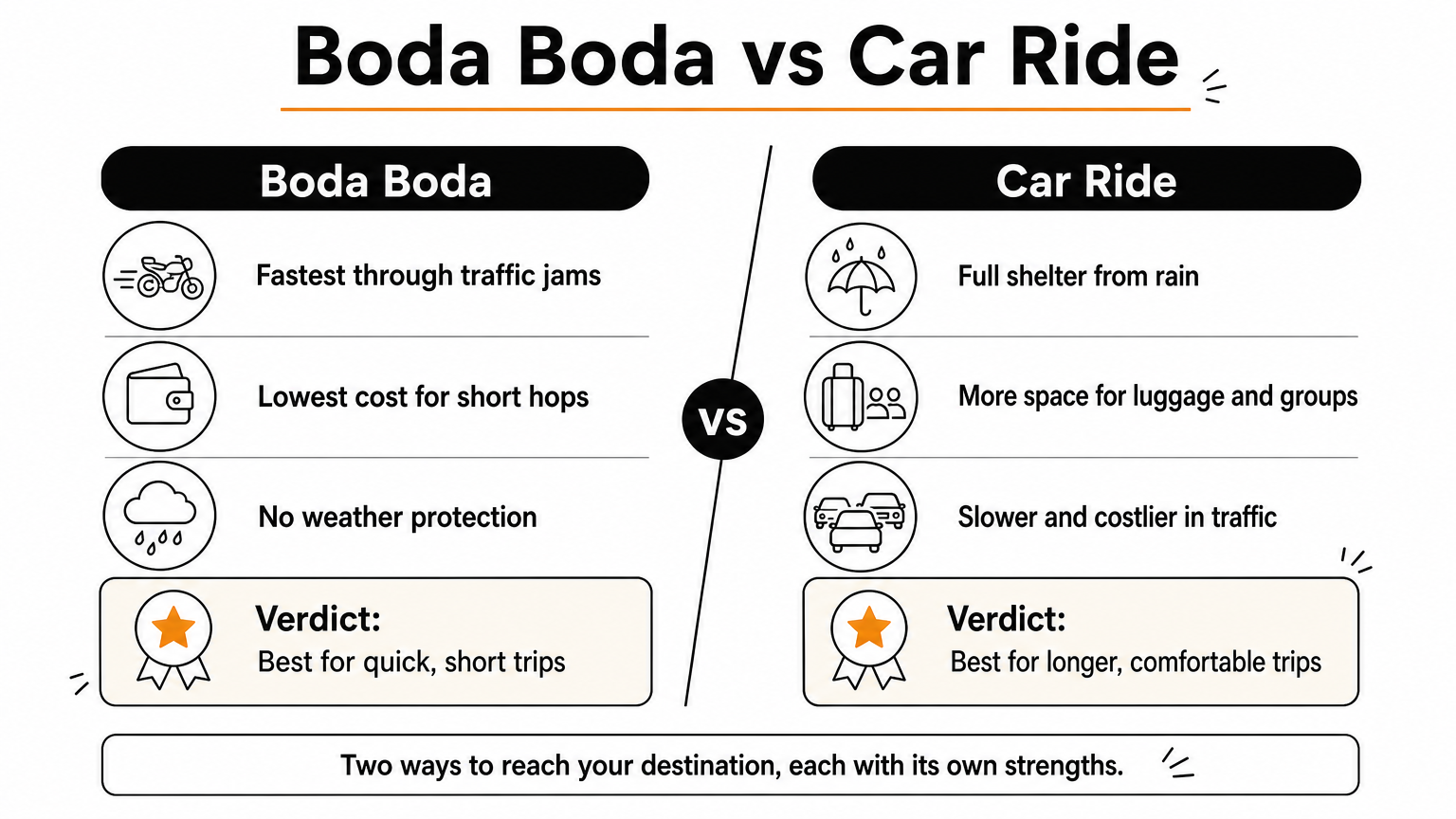
Speed costs comfort, and comfort costs time. Pick the trade-off that fits your trip.
Comparing the options at a glance
| Option | Best for | Typical cost | Weather protection |
|---|---|---|---|
| Boda boda | Short trips, beating traffic | Lowest for short hops | None |
| Car (taxi/app) | Longer trips, groups, luggage | Mid to high | Full |
| Matatu | Fixed routes, tight budgets | Lowest overall | Full |
| Walking | Under 1km, no cost | Free | None |
When each option actually makes sense
Gridlock on Waiyaki Way or Thika Road makes the choice obvious: a boda boda motorcycle splits lanes and reaches your meeting on time, while a car sits idle. Rain, luggage, or a group of three changes the math entirely, and a car becomes the safer, drier, more practical pick. Distance matters too. Under two kilometers, a boda is unbeatable. Beyond ten, the exposure and fatigue start outweighing the time saved.
Getting where you're going with boda bodas
A boda boda started as a shout across a border crossing and grew into the backbone of how Kenya moves. You now know where the name comes from, why over a million riders depend on it for income, and how the ride actually works from pickup to drop-off. Safety habits like checking for a helmet and sharing your trip location matter just as much as knowing when a boda beats a matatu or a car for your specific trip.
Next time you need to dodge Nairobi traffic or reach a corner a car can't touch, you already have the knowledge to ride smart. Booking through an app removes the guesswork on fare and rider identity, which is exactly what you want when speed and safety both count. Order a boda boda ride with eTaxi and get matched with a verified rider in minutes.